Carnival in Ancient Rome: a suspended time between chaos and rebirth

In ancient times, what we now call Carnival was not an isolated celebration, but part of a complex system of seasonal rituals. The period between the end of January and February represented a time of profound transition: winter was slowly giving its way to spring, and with it the rhythms of nature and daily life were changing. In this context, the festival took on an essential function: to create a space of freedom and controlled disorder before the return to stability. Ancient Carnival therefore originated as a collective response to a universal human need: to celebrate the end of one cycle and prepare for the next through laughter, excess and sharing. End-of-winter rituals and their connection to fertility In the Roman world, as in many ancient cultures, the transition from winter to spring was loaded with symbolic meaning. February, the month dedicated to purification (februare), marked the end of the agricultural and spiritual year. Before restoring order, it was necessary to go through a phase of apparent chaos, in which rules were suspended and social tensions eased. The festivals of this period often had a propitiatory function: they served to ensure the fertility of the fields, the health of the community and the continuity of life. The ancient Carnival was not just entertainment, but a collective ritual that connected man with the cycles of nature. Lupercalia: the human body at the centre of the festival Among the most emblematic celebrations were the Lupercalia, which took place on 15 February and perfectly embodied the spirit of carnival ante litteram. This festival, dedicated to the god Faunus/Lupercus, had a strongly physical and instinctive character. Participants ran through the streets of the city performing ritual gestures related to fertility and protection, in an atmosphere of unbridled popular participation. The body, often hidden or disciplined in everyday life, became the absolute protagonist: movement, contact, laughter and provocation were an integral part of the ritual. It is precisely in this centrality of the body that we recognise one of the most enduring elements of Carnival, which has survived over the centuries in the form of dances, masks and street parties. Disguises and identity reversal Another fundamental aspect of ancient Carnival was the temporary suspension of social identities, and this element has been handed down over time. During the festivities, hierarchies were loosened and roles could be questioned. Disguises, rudimentary masks and symbolic costumes allowed individuals to step out of their usual positions and experience a freedom that would otherwise have been unthinkable. This role-playing had not only a playful function, but also a social one: it allowed the community to renew itself, to observe itself from another perspective and to re-establish order with greater awareness once the festivities were over. Disguise, therefore, was not an escape from reality, but a tool useful to understand it better. The power of laughter and satire In ancient carnivals, laughter had a profound and almost therapeutic value. During the celebrations, freedom of speech that broke with convention was tolerated and often even encouraged: satire, jokes and mockery of the authorities were part of the ritual. This temporary licence allowed social tensions to be eased and strengthened the sense of belonging to the community itself. Ridiculing power did not mean destroying it, but making it more human. It is a dynamic that we still find today in modern Carnival, where parody becomes a tool for collective expression. Food and excess: nourishing body and spirit Like any respectable festival, ancient Carnival was also closely linked to food. Before periods of restriction or intense work, the community indulged in lavish banquets, rich in meat, wine, honey and hearty dishes. Eating together, without restraint, had a symbolic value: it represented the abundance desired for the coming year. Many gastronomic traditions of modern Carnival, such as fried and decidedly high-calorie desserts, have their roots in this culture of excess, where the pleasure of the table became a form of celebration of life. From ancient times to today’s Carnival With the advent of Christianity, these festivals did not disappear, but were reinterpreted and adapted. Carnival began to take on the role of the last space of freedom before the discipline of Lent, while maintaining its original spirit intact. Even today, among masks, rich dishes and moments of conviviality, we find the legacy of those ancient rites. Carnival continues to be a special time, when disorder is allowed and even necessary, because only by going through it can we return to order with new energy. Between shows, costumes, banquets and moments of suspension of the rules, many of the traditions we experience today during the festivities have their roots in a distant past, made up of conviviality, taste and freedom. If you love discovering how modern holidays are the result of centuries of history, we invite you to continue this journey through time by reading our in-depth articles dedicated to Christmas in Ancient Rome and Saturnalia, as well as historical curiosities about Roman cuisine, including ingredients, customs and flavours that still grace our tables today. At Ragno d’Oro, we believe that tradition is not just something to talk about, but something to be experienced every day, through dishes that respect authentic Roman cuisine and carry on its spirit, just as it was in ancient Rome. If you are in Rome and want to savour the true history of the capital, book your table and come and visit us in the heart of Prati! The story continues… at the table.
Citrus fruits in the kitchen: how winter smells of oranges and lemons

Winter has a unique scent: it smells of citrus fruits. In Lazio, as in most of central and southern Italy, oranges, lemons, mandarins and clementines are not just seasonal fruits to be enjoyed at the table, but true protagonists of winter cuisine and culture. In the kitchen, their presence can transform any dish, from pasta to desserts, adding a touch of freshness, fragrance and colour even on the gloomiest of days. But what makes citrus fruits so special? Let’s find it out together. Seasonal citrus fruits: the heart of winter in Lazio Citrus fruits are one of the most popular and versatile types of fruit in Italy. They are seasonal from autumn until late winter: oranges, mandarins, clementines and lemons are available during the cold months, with harvests often extending until the end of February or March, especially for late-season lemons and oranges. In Lazio, as in many regions of central and southern Italy, citrus fruits are often bought fresh at local markets and consumed both as fresh fruit and as ingredients in cooking. The winter season is the best time to enjoy their juice, fragrant peel and natural beneficial properties. Nutritional properties and benefits of citrus fruits Citrus fruits are not only tasty: they are rich in vitamins and nutrients. Oranges, mandarins, clementines and lemons contain high amounts of vitamin C, natural antioxidants and fiber, which make them useful for stimulating the immune system, promoting digestion and preventing seasonal illnesses typical of winter. These fruits are a valuable resource during the cold months, helping to rebalance the body after the festive season and keep you energetic and vital even when the sunlight diminishes. Incorporating them into your recipes is therefore not only a way to add a pleasant, fruity note to your meals, but also a real health boost. How to use citrus fruits in the kitchen In cooking, citrus fruits are not just squeezed for morning juice: their aromatic peel and intense juice are used in sweet and savoury recipes with surprising results. Oranges Oranges can be used in: fresh, colourful salads (also with fennel and olives) condiments for fish dishes homemade jams and marmalades desserts and spoon sweets Lemons Lemons are extremely versatile: their juice can replace vinegar in seasonal salads grated lemon zest adds flavour to pasta dishes (e.g. tagliolini with lemon and cooked ham) lemon accompanies fish and white meats with a fresh note the peel can be candied or used in homemade marmalades Mandarins The mandarin is one of the most aromatic citrus fruits. Its natural sweetness and fragrant peel make it ideal for delicate and mouth-watering dishes: fish carpaccio with mandarin vinaigrette duck breast or chicken with mandarin mandarin with cinnamon and honey cakes and marmalades Clementines Clementines are a cross between mandarins and oranges. They are less sour, juicy and easy to use in cooking: clementine, chicory and walnut salad clementine risotto clementine marmalade tart sorbets. In some Italian regions, citrus fruits such as lemons are also used to make artisanal liquors such as limoncello, a symbol of hospitality and conviviality at the end of a meal (although the tradition of limoncello is more firmly rooted in southern Italy). Citrus fruits are fantastic: they amplify flavours without overpowering them. In Lazio, their use in cooking is often subtle but effective: a dash of lemon juice on sautéed chicory or a plate of winter broccoli can lighten and enhance rustic flavours orange zest can complement meat dishes or seasonal salads with an unexpected aroma in homemade desserts, the combination of citrus fruits and dried fruit provides a balance between sweetness and freshness. Their intense aroma not only delights the palate but also lifts the spirits, bringing a touch of Mediterranean sunshine to the table on grey winter days. Conclusion: the winter scent in your plate Citrus fruits are much more than just a winter fruit. In Lazio and Rome, the citrus season brings freshness, colour, fragrance and flavour. Used in sweet or savoury recipes, citrus fruits such as oranges and lemons enrich everyday cooking with aromatic notes that brighten up dishes and the table. If you want to taste the authentic flavours of Roman winter, with fresh, seasonal ingredients and preparations that enhance the raw materials, book your table at Ragno D’Oro in the Prati district. We look forward to showing you how winter can also have a unique taste!
Christmas in Ancient Rome: Saturnalia, banquets and flavours
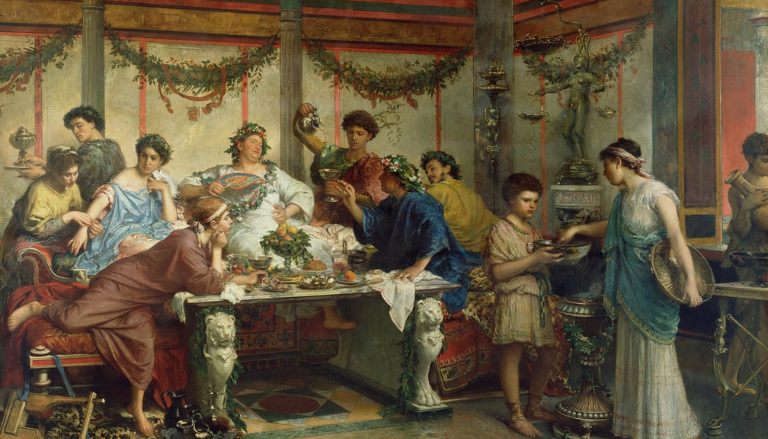
When we think of Christmas, we picture lights, nativity scenes, family dinners and presents under the tree. In Ancient Rome, however, the event that took place at the same time of year was not Christmas as we know it today, but rather Saturnalia: a popular and “reversing” festival that combined religion, conviviality and social licence. In this article, we will look at the similarities and differences between the two celebrations and discover the dishes and flavours that enlivened the tables during Saturnalia. Saturnalia: when, how and why Saturnalia were festivals in honour of the god Saturn, originally celebrated on 17th December in the Roman calendar and then gradually extended to 23rd December in the Imperial era, until it became a period of celebrations that could last a week. The festival included a public ceremony at the Temple of Saturn in the Forum, followed by private banquets, exchanges of gifts and a general festive atmosphere. A distinctive feature of Saturnalia was the suspension of social norms: a sort of symbolic “reversal” of roles was practiced (masters served slaves at table), gambling was allowed in public, and a carefree atmosphere prevailed, recalling the mythical ideal of the Golden Age. Over the centuries, this element of social inversion also influenced other European festivals and traditions. Saturnalia vs Christmas: similarities and differences Similarities Time of year and conviviality: both celebrations fall in the middle of winter (December) and are characterised by the centrality of banqueting, family gatherings and the exchange of gifts or presents. During Saturnalia, there was a practice of exchanging small gifts (such as the sigilla on Sigillaria day), a trait that clearly recalls the exchange of Christmas gifts. Decorations and symbols of light: although with different meanings, both pagan and Christian festivals used decorative elements to counteract the winter gloom (garlands, lights, evergreens). Differences Religious origin and meaning: Saturnalia was a pagan festival linked to agriculture and the worship of Saturn; Christmas is a Christian festival celebrating the birth of Jesus. The religious intent, symbolism and liturgical practices are therefore very different. Social character: while Christmas (in its modern forms) promotes values such as charity and family, Saturnalia emphasised the temporary breakdown of social hierarchies, ritual chaos and the allegory of freedom. Whereas Christmas tends to be institutionalised (masses, rituals), Saturnalia was a more “popular” and uninhibited festival. What did people eat during Saturnalia? The most popular dishes and ingredients Saturnalia was a synonym of abundance: ancient sources and modern reconstructions tell us of rich banquets, with meat, charcuterie, desserts and flavoured wine. Here is an overview of the specialities that recur most frequently in historical accounts and recipes taken from ancient texts (such as Apicius) and modern research. Meat, charcuterie and rich dishes Among meats, roast pork, hams and salted shoulders were highly prized; banquets could also feature lucanica (sausages), young goat and poultry dishes. Some recipes by Apicius and modern reconstructions suggest elaborate preparations with sweet and spicy sauces. Legumes and food of the common people For the ‘plebeian’ part of the festival, legumes (broad beans, chickpeas, lentils) were a basic food, inexpensive but substantial, often prepared in soups or stews. Cheese and bread also played a central role in common meals. Sweets and delicacies (dulcia) The Romans loved sweets: Saturnalia tables were full of dulcia (sweets), dried fruit, honey and fried or caramelised products. Some reconstructed recipes include mustacei (“must sweets”), dried fruit and fried sweets that we might associate with our winter treats today. Drinks: mulsum and spiced wine Mulsum, wine sweetened with honey, was a typical drink at Roman banquets and probably widely consumed during Saturnalia. Wine was often flavoured or mixed with spices and honey for festive occasions. Edible gifts and local specialities Sources also report the exchange of food products such as cheese, sweets and dried fruit as gifts. In some cases, masters offered gifts to slaves: this aspect of ritual generosity accompanied the element of the suspension of hierarchies. Why learn about Saturnalia today? A heritage of conviviality Why learn about Saturnalia today? A heritage of conviviality Studying Saturnalia does not mean “replacing” Christmas, but understanding the cultural roots that have spread across Europe: many festive practices, from decorating with evergreens to exchanging gifts, have parallels in pagan end-of-year rituals. Understanding these ties enriches our cultural and gastronomic experience, enriching the way we talk about the holidays and the dishes that accompany them. If you want to taste the Rome of the holidays, with revisited ancient recipes and seasonal flavours, come and visit us at Ragno D’Oro, in the heart of the Prati district. Book your table for December now and experience the festive atmosphere with us!
Autumn in Rome: 5 experiences to enjoy, including food, walks and culture
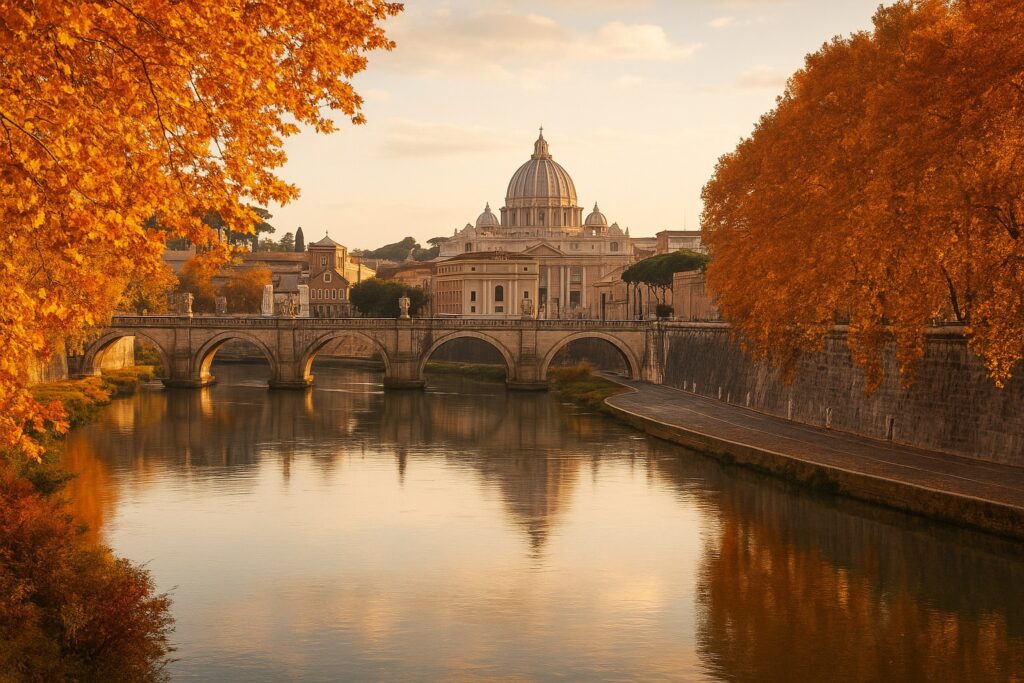
When the leaves on the trees turn gold and copper and the air becomes cooler, Rome shows a new side of itself: more intimate, authentic, perfect for those who want to enjoy the city out of season. During this period, the Prati district (where our restaurant is located) becomes the ideal starting point for experiencing autumn in Rome. Here are five unmissable activities for those visiting Rome in autumn (many of which can be combined with a convivial stop at Ragno d’Oro). 1. Strolling through parks and Roman villas Autumn transforms the capital’s parks into galleries of colour. Places such as Villa Borghese or Villa Doria Pamphili offer ideal settings for a relaxing walk among trees and ponds, in an atmosphere that exudes Roman tranquillity. Furthermore, walking along the Via Appia Antica with its centuries-old pine trees and ruins immersed in the woods is an evocative experience that autumn enhances. But it is not only nature that amazes: urban routes also tell stories. An unmissable destination for those who love the most authentic Rome is the Passetto di Borgo, the evocative elevated passageway connecting Castel Sant’Angelo with Vatican City, recently reopened to the public. This ancient papal corridor, about 800 metres long, offers a unique perspective on the rooftops of the Borgo district and the dome of St. Peter’s Basilica, making it an ideal stop for an autumn stroll through art, spirituality and historical secrets. 2. Autumn flavours: truffles, new wines and seasonal dishes With the arrival of the cold season, Rome offers a rich gastronomic repertoire: truffles, mushrooms, pumpkin, new wine. In autumn, flavours become more pronounced. It is the ideal time to abandon fresh salads and discover the fall dishes of Roman cuisine, such as creamy first courses or stews, perfect with a good glass of wine. At Ragno d’Oro, the seasonal menus feature selected seasonal ingredients that capture all the flavour of autumn in Rome. 3. Culture, exhibitions and festivals: Rome awakens Autumn in Rome is not only a season of colours, but also of ideas and creativity. After the calm of summer, the city is once again filled with cultural events, art exhibitions, festivals and shows that enliven theatres, squares and museums. It is the perfect time to discover the capital through experiences that combine culture and emotion. Every year, between October and November, the spotlight turns to the Rome Film Festival, one of the most eagerly awaited events, which brings directors and actors from all over the world to the red carpet of the Auditorium Parco della Musica. But the autumn calendar does not stop there: the Capitoline Museums, the Borghese Gallery and the MAXXI host temporary exhibitions and retrospectives dedicated to the great masters of art, while the contemporary art galleries in Trastevere and the Flaminio district offer more experimental itineraries. For music lovers, autumn in Rome is the season of the Roma Jazz Festival, which every year brings international artists to the stage in an elegant and intimate setting, and the Festival delle Letterature, which celebrates the written word with meetings with authors and readings under the stars. 4. Shopping and chic breaks in the streets of Rome Autumn brings with it new collections, boutiques, shop windows and captivating urban atmospheres. In Rome, areas such as Via del Corso and Via dei Condotti-Via Borgognona combine shopping with charm; shopping and strolling continue in Via Cola di Rienzo in the Prati district, which is full of various craft shops and other stores offering moments of leisure and well-being. A good idea: treat yourself to lunch or an aperitif at Il Ragno d’Oro before returning to the shop windows. 5. Romantic atmosphere, sunsets and hidden views One of the most popular places to admire the sunset is the Giardino degli Aranci (Orange Garden) on the Aventine Hill, which offers a breathtaking view of St. Peter’s Dome. Not far away, the famous ‘Keyhole’ reveals a unique perspective of the city, perfectly framing the Basilica in a play of light and shadow that becomes pure magic at sunset. The Pincio Terrace in Villa Borghese also offers spectacular views: from its balustrades, you can admire Piazza del Popolo as it lights up with orange shades while the city prepares for the evening. For photography enthusiasts, this is the ideal time to capture Rome in its most authentic guise: the reflections of the Tiber at sunset, the leaves falling along the tree-lined avenues and the monuments tinged with gold and copper. But autumn in Rome is not just about views: it is also the perfect time to lose yourself in the lesser-known alleys, such as those of the Jewish Ghetto, the Monti district or Trastevere, where you can experience a quieter Rome, made up of historic shops, lit lanterns and chatter echoing through the small squares. Walking around the city at this time of year means rediscovering the pleasure of slowing down, letting yourself be surprised by quiet corners and hidden glimpses that only autumn can make so evocative. If you have spent the day exploring Rome, walking in the park, visiting exhibitions or shopping, treat yourself to the relaxation you deserve. At Ragno d’Oro, we welcome you with authentic flavours, a Roman atmosphere and dishes designed for autumn: from hot pasta to hearty dishes and seasonal desserts. We are located in the Prati district: easy to reach, perfect before or after an evening in the city centre. Book your table: ending the day with a flavourful dinner is the best way to take away a memory of Rome that will remain… in your stomach and in your heart.
The Rome Film Festival: autumn’s beating heart
Every autumn, Rome glows with lights, red carpets and film lovers from all over the world: from 15 to 26 October 2025, the 20th edition of the Rome Film Festival will take place, an international event that transforms the capital into a stage under the stars. But what does a Roman osteria like ours have to do with cinema? Much more than you might imagine. This period is the perfect opportunity to combine culture, atmosphere and culinary delights for those who love to take their seats in a theatre and then sit down at the table. The Festival The Film Festival, held at the Auditorium Parco della Musica, hosted numerous screening rooms, related events, red carpet appearances and meetings with authors and actors. This year, the Festival celebrated its 20th anniversary with a rich schedule: over 150 titles including movies, documentaries, retrospectives, “Best of” events and special screenings. Starting on 15 October with Riccardo Milani’s “La vita va così” (Life Goes This Way), it will close on the 26th of the month. The festival is not confined to the Auditorium area: complementary events extend to other cultural spaces in the city, involving neighbourhoods, art galleries, exhibitions and installations. It is clear that those who come to Rome for the festival are not only looking for projections, but also for the experience of “living Rome”, and this opens up space for dialogue between cinema and food. Cinema and food: a scenario to experience together After an evening at the cinema, there is nothing that warms the heart like a typical Roman dish. A steaming plate of amatriciana, a well-made carbonara or a seasonal dish with mushrooms: all offer that sense of belonging, territoriality and conviviality that is lacking from the solo cinema experience. Cinema makes you travel, it excites you and makes you think. Food does the same thing: every dish has a story, an origin, a culture. Offering typical dishes is like offering the audience an “extra scene”, an immersive moment beyond the cinema theatre. Practical advice for festival visitors Our restaurant is located in the Prati district: a convenient location for those arriving from various central areas. Book in advance: during the festival, many cinemas, restaurants and bars will be full. We offer hot, traditional dishes and ‘just the right’ portions for those who don’t want to eat a heavy meal before returning to their hotel or continuing their evening. If you happen to be in Rome for the Film Festival during this period, don’t let the experience end at the cinema. Come and have lunch or dinner at Il Ragno D’Oro: we are waiting for you with typical Roman dishes, a warm atmosphere and the desire to turn an evening at the cinema into an unforgettable memory. Book your table or ask us for the seasonal dish to enjoy while you let yourself be inspired by the big screen!
Autumn dishes of Roman cuisine: typical tastes to enjoy
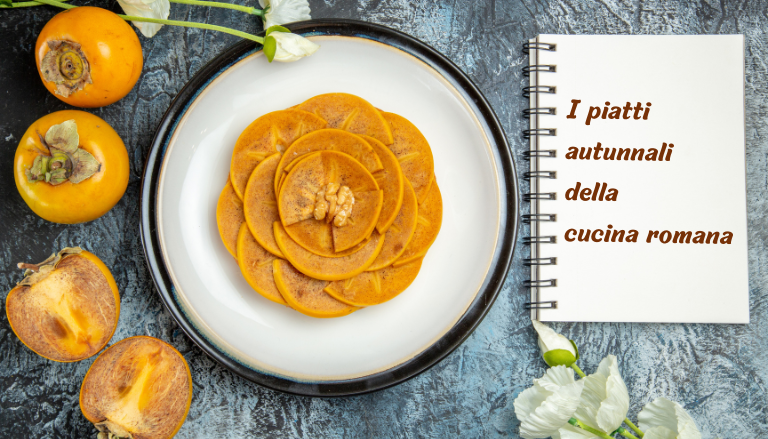
With the arrival of autumn, Rome changes its appearance: the streets are coloured with warm shades, the air becomes crisper and seasonal ingredients enrich traditional dishes. Roman cuisine, famous for its authenticity and intense flavours, finds the perfect ally in this season for rich and mouth-watering dishes. Let’s discover together several typical Roman autumn meals, some of which can be enjoyed at Il Ragno d’Oro, the historic tavern in Prati. 1. Mushrooms and fresh pasta: an irresistible combination Porcini mushrooms and champignons are the unquestioned stars of Roman autumn recipes. They are usually paired with fresh tagliatelle or a rich, aromatic and creamy risotto that evokes the flavours of the forest (where it is always nice to take a walk on cool autumn days). 2. Chicory sautéed in garlic, oil and chilli pepper: the ideal Roman side dish Autumn brings bold-flavoured vegetables to the table, and chicory sautéed in a pan with garlic, oil and chilli pepper is one of Rome’s most beloved side dishes: bitter to just the right degree, it is perfect for accompanying meat dishes such as coda alla vaccinara (oxtail stew) or tripe. 3. Coda alla vaccinara: Roman comfort food If there is one dish that tastes like autumn, it is this: coda alla vaccinara, slow to cook and rich in flavour, is a meat stew accompanied by vegetables and a touch of bitter cocoa. A classic of Roman peasant cuisine, today it conquers the palates of those seeking authentic and timeless dishes. 4. Baked potatoes and lamb: a winning combination Roast potatoes are a protagonist on Roman tables in every season, but in autumn they perfectly accompany one of the most iconic main courses: roast lamb. A dish that combines tender meat with the aroma of Mediterranean herbs… simply unique, try it to believe it! 5. Pumpkin: sweetness, colour and versatility Autumn brings with it the return of pumpkin to market stalls and Roman kitchens: an ingredient whose warm colour and sweet, earthy flavour can transform simple dishes into comforting experiences. Although there are no ancient dishes with pumpkin documented as an integral part of the most archaic Roman tradition, in recent decades this product has become a staple of the Roman seasonal repertoire, paired with cheese, pasta, aromatic herbs and often reinterpreted with modern touches, while respecting the rustic character of Roman cuisine. Some examples of revisited classic dishes are the timeless cacio e pepe with pumpkin and Roman gnocchi, which are prepared with semolina and pumpkin. 6. Legume soups: tradition and warmth With the first cold weather, a warm bean or chickpea soup is a must, often enriched with short pasta or homemade bread croutons. Simple, timeless recipes that warm the body and spirit, just as traditional Roman cuisine intended. 7. Autumn desserts and fruits To end on a sweet note, Roman tradition offers roasted chestnuts, to be eaten on their own or as part of cakes or pastries, perhaps accompanied by a glass of “novello” wine. This combination evokes the scent of popular festivals and the sense of community typical of taverns, immersing you in a special atmosphere. In addition, at our tavern, you will find the perfect dessert for this season: persimmon sorbet with the addition of whipped cream and dark chocolate shavings. 30 Autumn in Rome is an invitation to the table: warm, authentic dishes linked to tradition that find new life in the cuisine of Ragno d’Oro. If you are in Rome and find yourself in the Prati district, come and visit us: a genuine menu that smells of history and conviviality awaits you. Contact us now to book your table in advance!
Interesting facts you didn’t know about the Prati district
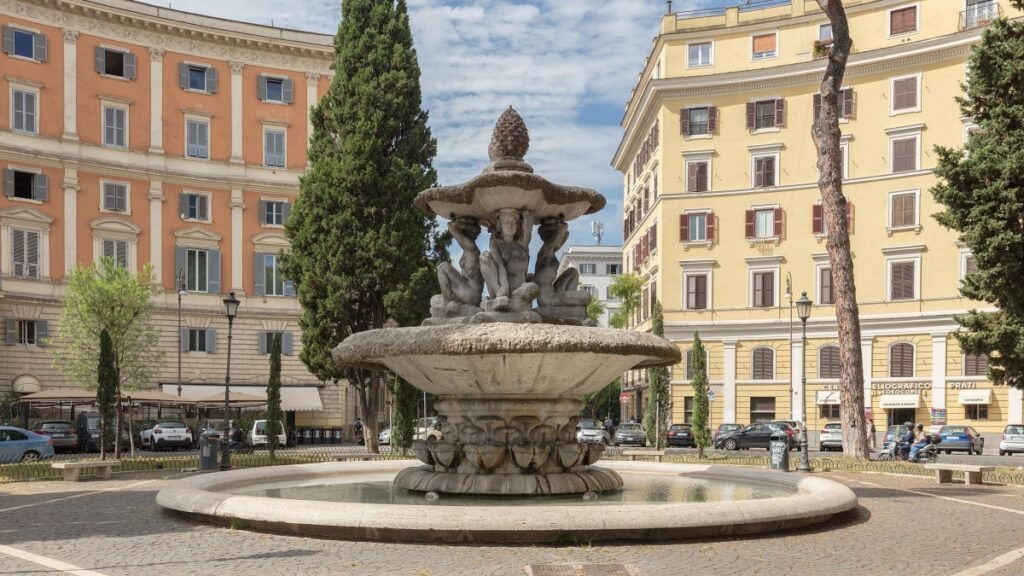
Today, the Prati district is one of the busiest and most historic places in Rome, full of art and tradition. Yet, this place hides some unexpected curiosities. Today we are here to share them in this article! The origins of the name Until 1883, this area, now known as the Prati district, consisted of vast cultivated and natural fields, swamps that were only later cleared and a few isolated farmhouses, while in even older Roman times it was common to find canes and vineyards, property of Domizia. Once called ‘Prati di Castello’ in reference to its proximity to the famous Castel Sant’Angelo, from this it currently maintains its name ‘Prati’, a symbol of what it was in ancient times. With the taking of Rome in 1870 and the subsequent Plan of 1883, this large natural area was urbanised and built up to what we are familiar with today, with the official constitution of the district in August 1921. Prati: originally a laic neighbourhood Today, when we think of this iconic Roman neighbourhood, we tend to associate it with the large groups of tourists and religious people who colour the streets, moved by their faith and their desire to visit the Christian places of worship that flourished in this specific area. It may surprise you to know that, following the 1883 ordinance, the Rome City Council indicated a very specific predisposition for the new urbanisation of the area: it was essential that the vision of St. Peter’s dome was obstructed by any means. This is explained by the fact that that historical period was characterised by tensions between the State and the Church; we are in fact in post-unification Italy, and the broad anti-clergy stance was no secret. This is how this area came to host the administrative and military structures of the Kingdom of Italy; indeed, it is enough to note how the names of the streets still refer to the great commanders, literary and secular figures and heroes of the Renaissance from whom the historic square takes its name. The differences between yesterday and today From an area of endless greenery to an elegant area full of knowledge, from the ancient to the modern that we now breathe. Today and compared to the past, the Prati district is an increasingly commercial and touristic area, full of cultural and entertainment attractions in a larger sense, like the many markets, among which the Mercato Trionfale stands out, that contribute to animate the streets or buildings that house organs of national importance, such as the Court of Justice in Piazza Cavour. Clear is how its economy is no longer based on the mere agricultural aspect. On the building level, however, it can be seen that while there used to be more irregularity, with a predominant Art Nouveau style and buildings of different sizes, today the style that characterises it is Umbertine, with strong geometries and symmetries that confer it its iconic elegance. These modern differences give it a prestigious real estate value, definitely not to be underestimated. It is certainly very interesting to discover how sometimes what we are used to can hide almost opposite origins. We hope we have provided you with a few more cultural insights with this article, to be remembered the next time you decide to immerse yourself in the streets of one of the most densely populated districts of the beautiful city of Rome. And if you get a bit of an appetite while strolling, remember that the team of Ragno D’Oro awaits you with open arms every day at Via Silla 26. Contact us now to book your table!
Easter desserts in Rome and Lazio

The joyful Easter season is approaching and along with it, tables are filled with delicacies. In this article we will take a look at the Easter sweets in Rome and Lazio, which have always added flavour and colour to this important holiday, making it even more magical and characteristic. Sweet Roman pizza Also better known as pizza cresciuta, this is not a real pizza, but a tall, fluffy cake, the preparation of which takes at least two days and a lot of patience. Also present in its salty version, in this section we will focus on describing the sweet version, with its special cinnamon flavour and the presence of candied citrus fruits. Each family, however, has its own special trick up its sleeve in the preparation of this typical Latium dish, in fact in some of its versions we can find anise seeds, nutmeg and/or liqueurs such as alchermes or maraschino. In all its variations, however, it remains a much-loved and essential dessert during this festive season. Pizza sbattuta We now proceed to the second sweet pizza typical of the Roman area, but again this is not a real pizza. Pizza sbattuta takes its name from its preparation, in fact it is a very soft and light cake without the use of yeast, perfect to be combined with sweet creams or chocolate Easter eggs. To give it its shape, it is necessary to beat the eggs and sugar together for a long time, at least an hour, in order to obtain a foamy and light mixture to which a bit of lemon peel and icing sugar is usually added to finish it off nicely. Easter Tortano It is a variant of the Easter cake from the lower Lazio region, decorated on the outside with an egg white and sugar-based icing called “naspro”, decorated according to personal preferences with coloured sprinkles and sugared candies. Tortano is a cake that has been left to rise for hours and, except for the icing, it is not very sweet. In fact, the characteristic flavour is given by the presence of anise seeds in the mixture and the use of liqueur. It is also available in its variant with a typical ring-shaped cake called tortero di Lenola, to which the outer sprinkles are usually not added. Pasqualina cake Whereas towards Anagni we find the pasqualina cake, which looks similar to a filled tart: this typical dessert from Ciociaria has a fragrant outer crust and a soft filling of ricotta, rum and alchermes. In conclusion, when Easter approaches, Lazio is overwhelmed by the flavours and aromas of these delicious sweets, an integral part of tradition. In fact, those we have listed in this article are only some of the most popular, but we invite you to explore this region rich in history and culture to discover other variants, similar in ingredients but different in shape and history.
March vegetables
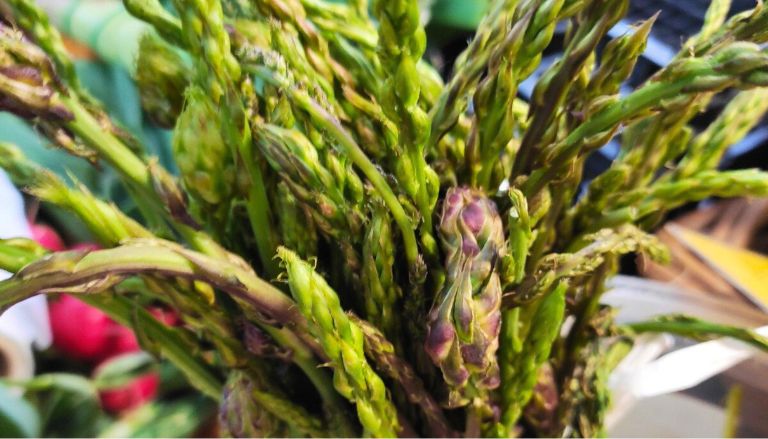
Spring is coming and it brings with it a delightful air of change, which is also reflected in the choice of primary ingredients. In this article we are going to look at which vegetables are in March and how they can be used in the kitchen. Artichokes Popular in Roman cuisine, artichokes are among the leading protagonists of this season. With their unique taste, they possess many beneficial effects for different areas of the human body. They are in fact rich in fiber and contribute to intestinal regularity by helping digestion. In addition they contain potassium, support cardiovascular health and strengthen the immune system thanks to the presence of vitamins A, B and C and K. Versatile and tasty, we find them in many recipes and in Rome you cannot miss trying their famous variant “alla Giudia” which involves crispy frying, making them perfect both as an appetizer and as a vegetable side dish or second course. To find out more about the importance of this vegetable in Roman tradition read our dedicated article! Asparagus Rich in water, vitamins A, C and E and minerals, low in fat and cholesterol-free, asparagus makes its way into spring, ready more than ever to spice up many of your dishes. As well as their cousins artichokes, they are a food you should introduce into your diet for the many benefits they are able to bring to your health. As mentioned earlier, this vegetable has an important diuretic power that makes it particularly recommended for those who suffer from high blood pressure and heart problems; it is also very important for muscle health and helps to fight the development of cellulite. In Rome, asparagus is an essential ingredient for the proper success of Vignarola Romana: it is a typical dish made with fresh vegetables among which we also find the previously mentioned artichokes, along with broad beans, peas and Roman lettuce. For those who love strong flavors, it is possible to enrich it with pork cheek and a splash of wine. This recipe is perfect as a side dish, main course or also lends itself well as a good condiment for pasta. Bitter vegetables Seasonal vegetables also include bitter ones, such as chicory or puntarelle. These carry with them a considerable amount of beneficial properties: they are useful for regulating blood sugar levels, in digestion and against constipation, essential for proper liver function, strengthen the immune system and are rich in vitamins, minerals and antioxidants. But how do they perform in the kitchen? Bitter spring vegetables are ideal as a side dish, lightly tossed in a frying pan or grilled with a drop of oil that can enhance their unique and sharp taste, but you can find them in many recipes or in combination with other raw materials as it happens with anchovies in the case of the typical Roman salad of puntarelle. We are waiting for you every day at Ragno D’Oro where you can taste some of these recipes that we daily prepare with all the love and care expected from traditional Roman cuisine. Contact us now to reserve your table!
Carnival in the Roman tradition
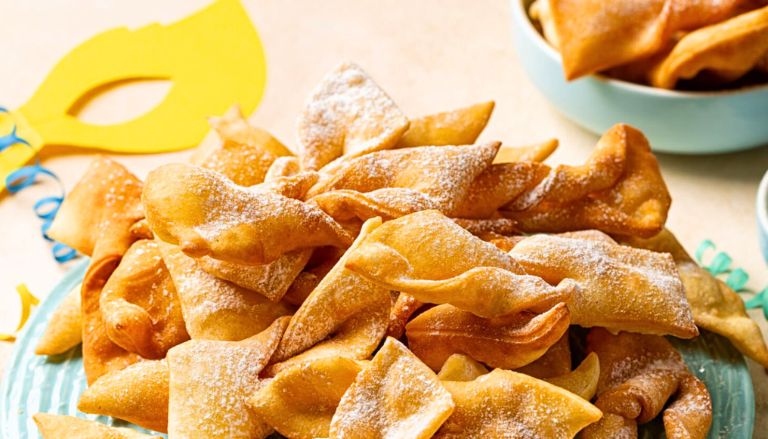
We are now in the most cheerful time of the year with costumes, festoons and confetti populating the squares and filling them with colour, while mouth-watering dishes fill the tables of Italians. In this article we will talk about Carnival in the Roman culinary tradition, so get ready for plenty of sweets with frappe, castagnole and ravioli! Frappe Fried or baked, frappes are crispy golden strips covered with powdered sugar. You can find them either plain or flavoured with vanilla or various liquors and covered in chocolate for the sweet-toothed. Today, they are considered the descendants of the ancient Roman frictilia, typical sweets fried in pork grease, which were distributed in the streets on the occasion of Saturnalia, when people celebrated gluttony and the abundance of the earth. Castagnole Also available in both a fried version and a lighter oven-baked variant, castagnole are the ultimate sweet when it comes to Roman Carnival. Their shape is reminiscent of chestnuts, from which they take their name, but they are balls of baked dough covered in granulated sugar. There are ones for all tastes, in fact you can enjoy them plain or filled with cream, ricotta or chocolate. Ravioli Last, but not least in terms of goodness, we find ravioli. Similar in shape to the famous pasta, but don’t be fooled: these are real desserts! Fried or baked, their strength is their filling, which in the most traditional versions includes chocolate, ricotta or even cinnamon, although today there are many variations, such as cream-flavoured or fruit jams. Now that we have told you about these delicacies, don’t waste any time and hurry up and taste them while they are available! For a dive into traditional Roman cuisine, we are waiting for you every day at Ragno D’Oro in Via Silla 26, 00192 Rome. Call us on 06 321 2362 to reserve a table or use the form on our website.