Carnival in Ancient Rome: a suspended time between chaos and rebirth

In ancient times, what we now call Carnival was not an isolated celebration, but part of a complex system of seasonal rituals. The period between the end of January and February represented a time of profound transition: winter was slowly giving its way to spring, and with it the rhythms of nature and daily life were changing. In this context, the festival took on an essential function: to create a space of freedom and controlled disorder before the return to stability. Ancient Carnival therefore originated as a collective response to a universal human need: to celebrate the end of one cycle and prepare for the next through laughter, excess and sharing. End-of-winter rituals and their connection to fertility In the Roman world, as in many ancient cultures, the transition from winter to spring was loaded with symbolic meaning. February, the month dedicated to purification (februare), marked the end of the agricultural and spiritual year. Before restoring order, it was necessary to go through a phase of apparent chaos, in which rules were suspended and social tensions eased. The festivals of this period often had a propitiatory function: they served to ensure the fertility of the fields, the health of the community and the continuity of life. The ancient Carnival was not just entertainment, but a collective ritual that connected man with the cycles of nature. Lupercalia: the human body at the centre of the festival Among the most emblematic celebrations were the Lupercalia, which took place on 15 February and perfectly embodied the spirit of carnival ante litteram. This festival, dedicated to the god Faunus/Lupercus, had a strongly physical and instinctive character. Participants ran through the streets of the city performing ritual gestures related to fertility and protection, in an atmosphere of unbridled popular participation. The body, often hidden or disciplined in everyday life, became the absolute protagonist: movement, contact, laughter and provocation were an integral part of the ritual. It is precisely in this centrality of the body that we recognise one of the most enduring elements of Carnival, which has survived over the centuries in the form of dances, masks and street parties. Disguises and identity reversal Another fundamental aspect of ancient Carnival was the temporary suspension of social identities, and this element has been handed down over time. During the festivities, hierarchies were loosened and roles could be questioned. Disguises, rudimentary masks and symbolic costumes allowed individuals to step out of their usual positions and experience a freedom that would otherwise have been unthinkable. This role-playing had not only a playful function, but also a social one: it allowed the community to renew itself, to observe itself from another perspective and to re-establish order with greater awareness once the festivities were over. Disguise, therefore, was not an escape from reality, but a tool useful to understand it better. The power of laughter and satire In ancient carnivals, laughter had a profound and almost therapeutic value. During the celebrations, freedom of speech that broke with convention was tolerated and often even encouraged: satire, jokes and mockery of the authorities were part of the ritual. This temporary licence allowed social tensions to be eased and strengthened the sense of belonging to the community itself. Ridiculing power did not mean destroying it, but making it more human. It is a dynamic that we still find today in modern Carnival, where parody becomes a tool for collective expression. Food and excess: nourishing body and spirit Like any respectable festival, ancient Carnival was also closely linked to food. Before periods of restriction or intense work, the community indulged in lavish banquets, rich in meat, wine, honey and hearty dishes. Eating together, without restraint, had a symbolic value: it represented the abundance desired for the coming year. Many gastronomic traditions of modern Carnival, such as fried and decidedly high-calorie desserts, have their roots in this culture of excess, where the pleasure of the table became a form of celebration of life. From ancient times to today’s Carnival With the advent of Christianity, these festivals did not disappear, but were reinterpreted and adapted. Carnival began to take on the role of the last space of freedom before the discipline of Lent, while maintaining its original spirit intact. Even today, among masks, rich dishes and moments of conviviality, we find the legacy of those ancient rites. Carnival continues to be a special time, when disorder is allowed and even necessary, because only by going through it can we return to order with new energy. Between shows, costumes, banquets and moments of suspension of the rules, many of the traditions we experience today during the festivities have their roots in a distant past, made up of conviviality, taste and freedom. If you love discovering how modern holidays are the result of centuries of history, we invite you to continue this journey through time by reading our in-depth articles dedicated to Christmas in Ancient Rome and Saturnalia, as well as historical curiosities about Roman cuisine, including ingredients, customs and flavours that still grace our tables today.  At Ragno d’Oro, we believe that tradition is not just something to talk about, but something to be experienced every day, through dishes that respect authentic Roman cuisine and carry on its spirit, just as it was in ancient Rome. If you are in Rome and want to savour the true history of the capital, book your table and come and visit us in the heart of Prati! The story continues… at the table.

Carnival in the Roman tradition
Carnevale nella tradizione romana

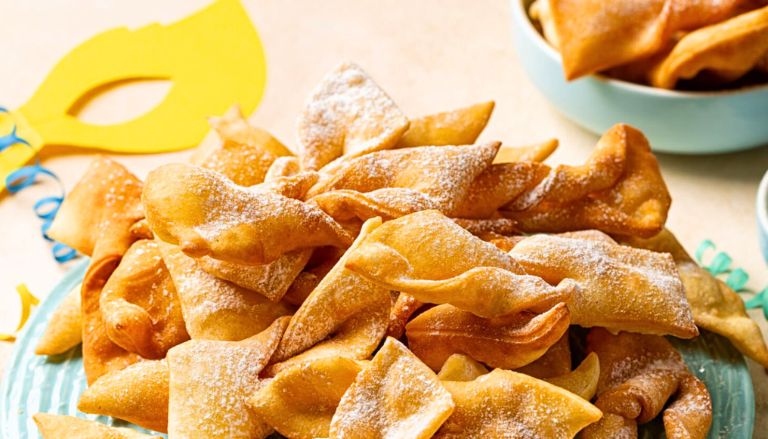
We are now in the most cheerful time of the year with costumes, festoons and confetti populating the squares and filling them with colour, while mouth-watering dishes fill the tables of Italians. In this article we will talk about Carnival in the Roman culinary tradition, so get ready for plenty of sweets with frappe, castagnole and ravioli! Frappe Fried or baked, frappes are crispy golden strips covered with powdered sugar. You can find them either plain or flavoured with vanilla or various liquors and covered in chocolate for the sweet-toothed.  Today, they are considered the descendants of the ancient Roman frictilia, typical sweets fried in pork grease, which were distributed in the streets on the occasion of Saturnalia, when people celebrated gluttony and the abundance of the earth. Castagnole Also available in both a fried version and a lighter oven-baked variant, castagnole are the ultimate sweet when it comes to Roman Carnival. Their shape is reminiscent of chestnuts, from which they take their name, but they are balls of baked dough covered in granulated sugar. There are ones for all tastes, in fact you can enjoy them plain or filled with cream, ricotta or chocolate.  Ravioli Last, but not least in terms of goodness, we find ravioli. Similar in shape to the famous pasta, but don’t be fooled: these are real desserts!  Fried or baked, their strength is their filling, which in the most traditional versions includes chocolate, ricotta or even cinnamon, although today there are many variations, such as cream-flavoured or fruit jams.  Now that we have told you about these delicacies, don’t waste any time and hurry up and taste them while they are available! For a dive into traditional Roman cuisine, we are waiting for you every day at Ragno D’Oro in Via Silla 26, 00192 Rome.  Call us on 06 321 2362 to reserve a table or use the form on our website.