Thursday gnocchi: where does the tradition come from?
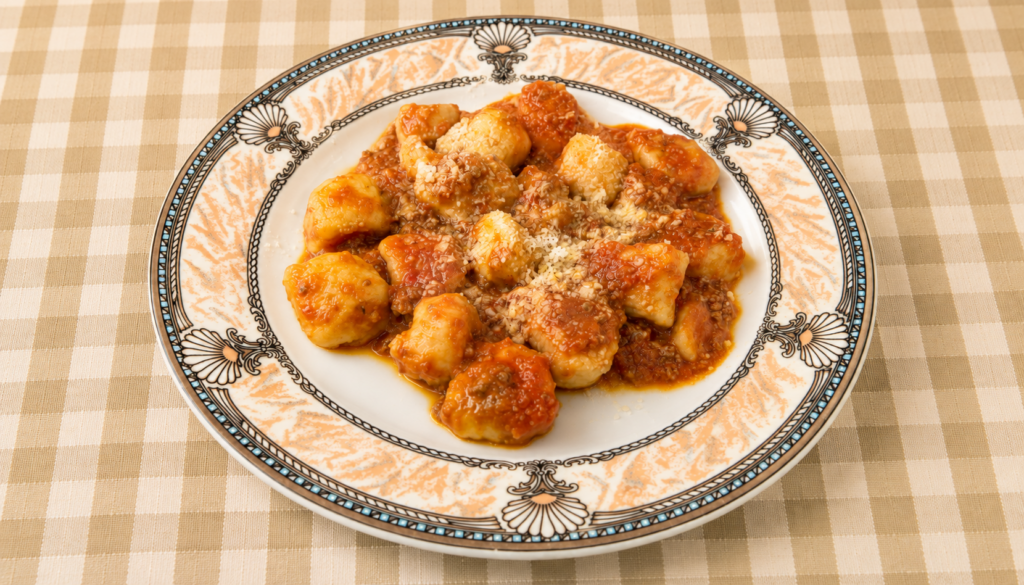
“Thursday gnocchi.” How many times have we heard this phrase? It is one of the most famous sayings associated with Roman cuisine, and even today, walking among the osterias and trattorias of the Capital, it is common to find gnocchi as the star of Thursday’s menu. But where does this tradition come from? And why specifically Thursday? Behind a simple plate of gnocchi lies a story that reveals a lot about Roman cuisine and Italy itself: a culinary tradition built over time through simple ingredients, family habits, religious observances, and the knack for turning whatever was on hand into something delicious. Why do people say “Thursday gnocchi”? The full proverb is “Giovedì gnocchi, venerdì pesce, sabato trippa” (“Thursday gnocchi, Friday fish, Saturday tripe”) and is traditionally associated with Roman popular culture, particularly in the working-class neighborhoods of the city. According to a widely accepted account, the custom consolidated after World War II, when families had to contend with ingredient shortages and the need to organize meals in an economical, nourishing way. Thursday became the perfect day to serve a substantial dish like potato gnocchi: simple, filling, and made with relatively inexpensive ingredients. The choice was also tied to the following day. Friday, according to Catholic tradition, was a “lean day” when meat was avoided. In Rome, dishes centered around fish and legumes were especially common, such as the famous salt cod with chickpeas. Then came Saturday, associated with tripe and the “fifth quarter”, the offal and less noble cuts of meat that Roman popular cuisine masterfully transformed into iconic recipes. In short, an entire week could almost be narrated through the menu. A curious fact: the saying might be older than world war II While the post WWII era certainly helped cement this custom, the story behind the saying may be even older. Historical records cited by various sources trace the expression back to at least the mid-19th century, when an anonymous poem in Roman dialect paired specific traditional dishes with different days of the week. This makes the story of “Thursday gnocchi” even more fascinating: it is not merely a habit born out of 20th-century necessity, but a tradition deeply rooted in a much older way of experiencing the dining table. As often happens in popular culture, customs born from practical needs eventually become part of a city’s identity. From gnocchi to roman cuisine: when simplicity becomes identity The story of gnocchi perfectly illustrates one of the defining traits of roman cuisine: the ability to take simple ingredients and elevate them into recognizable dishes deeply rooted in the local culture. Rome’s gastronomy was born from the intersection of many stories: families, markets, osterias, labor, and religious traditions. It is a humble, down-to-earth cuisine, often shaped by the principle of letting nothing go to waste. The “fifth quarter” is one of the most significant examples: ox tail, tripe, sweetbreads, organ meats, and other humble cuts became the stars of some of Rome’s best-known recipes. The same principle applies to many other traditional dishes: from carbonara to amatriciana, cacio e pepe to gricia, all the way to Roman-style and Jewish-style artichokes. Different recipes, but united by a single thread: a cuisine capable of celebrating quality raw ingredients without overcomplicating them. Gnocchi and the “Ottobrate Romane” There is another curious connection between gnocchi and the history of Rome. In the past, gnocchi were a centerpiece of the ottobrate romane, the famous autumn day trips organized during October to celebrate the end of the grape harvest. These were festive occasions filled with music, dancing, wine, and grand feasts. Among the indispensable dishes served were gnocchi, alongside tripe and roast suckling lamb. The ottobrate represented roman conviviality at its finest: gathering together, eating, drinking, and spending a day outside the city walls. It is a spirit that lives on today in the culture of Rome’s osterias. Why is “Thursday gnocchi” still relevant today? Today, we no longer need to plan our weekly meals based on ingredient scarcity or historical religious rules. And yet, Thursday gnocchi remains a living tradition. Perhaps the reason is simple: certain culinary habits end up becoming part of the collective memory. It is no longer just about why they started, but what they represent. Ordering a plate of gnocchi in a roman osteria on a Thursday means reconnecting, if only for a moment, with a piece of the city’s history. Because food isn’t just what we put on our plate. It is also when we eat it, who we share it with, and the stories it carries. And that is perhaps the true beauty of Roman tradition: behind a deceptively simple dish lies an entire history. Thursday gnocchi, then just as tradition demands And if you want to savor the authentic atmosphere of roman cuisine, we look forward to welcoming you to Osteria Ragno d’Oro, in the heart of the Prati neighborhood, just steps from St. Peter’s Basilica and the Vatican Museums. Book your table now!